Sustainability

Our three pillars
Sustainable properties and places

People, culture, and community

Corporate governance and performance
Material issues drive our sustainability strategy
Goodman’s material issues help us prioritise what matters most. We consider ESG issues to be material if they have the potential to impact our financial performance or reputation, or the expectations of our stakeholders. We review our material issues regularly, so they remain current and connected to our core business. The following eight material ESG priorities inform our 2030 Sustainability strategy and targets:
- Actively pursuing opportunities to reduce our emissions intensity
- Owning strategically located properties close to consumers in key global markets
- Developing and adapting properties that have an ability to be highly productive
- Delivering resilient assets that support human health
- Demonstrating Goodman’s values and promoting diversity, inclusiveness and social equity
- Investing responsibly and with defined governance and sustainable capital structures
- Sustainable sourcing, including environmental and social considerations to influence (where appropriate and possible) on the practices of parties in our value chain
- Promoting workplace safety and wellbeing.


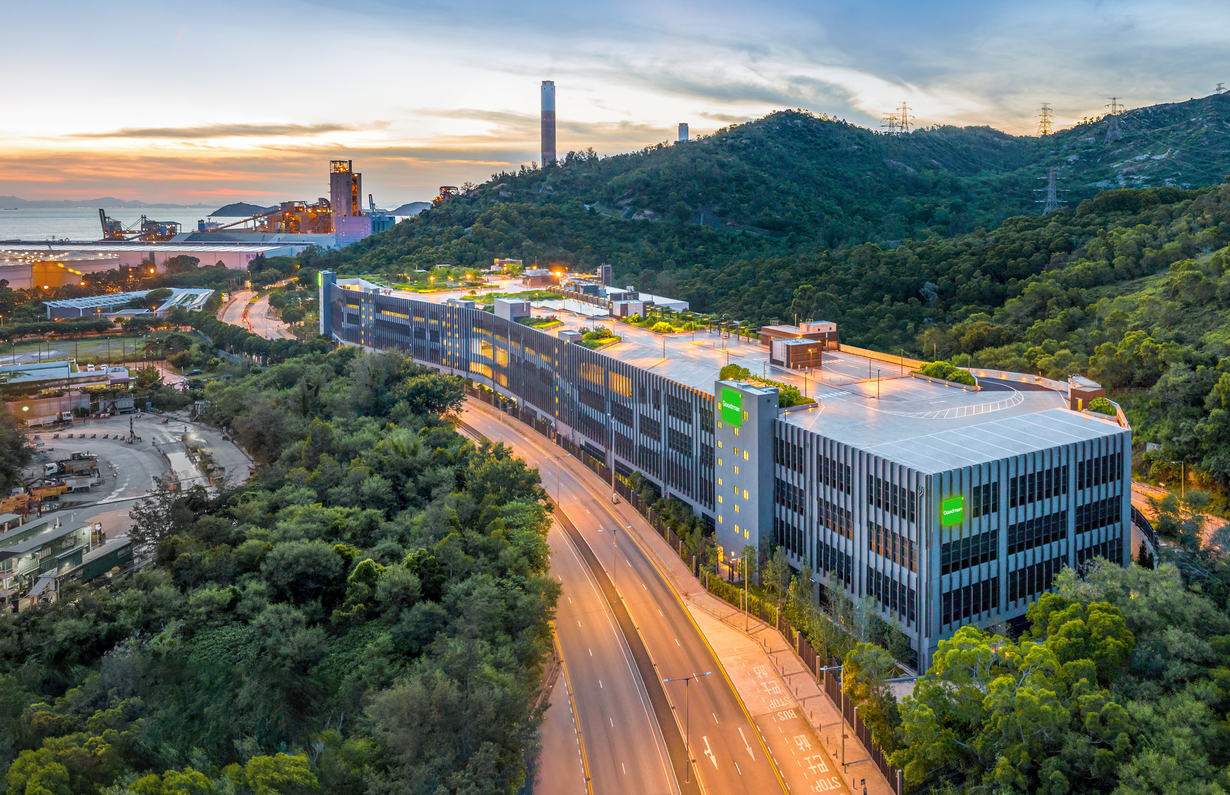
WELL Health-Safety Rating for 10 Hong Kong properties
In Hong Kong, urban density means our properties are central hubs and home to bigger workforces than many other locations.

Sustainability excellence in action in Milan
In East Milan, Goodman’s new Pioltello Logistics Centre has achieved one of the highest BREEAM rating scores for a logistics asset in Italy. The property achieved BREEAM New Construction Excellent certification with an outstanding score of 79.5%.

Green building certification
Goodman combines sustainable design principles and construction methods, with innovative materials to deliver green buildings for our customers around the world.

Designing circularity into deconstruction – reusing materials at Tremblay-en-France
At Tremblay-en-France, 30km from the centre of Paris, Goodman was able to reuse, recover or recycle 99.1% of waste from old buildings on this brownfield site.

Goodman Business Park
Goodman Business Park in Greater Tokyo, Japan boosts employee well-being by day and delights local residents by night.

Revitalising our portfolio
Not all brownfield developments are newly acquired. Our practice of buying strategically located sites means we already own some older sites well positioned for redevelopment. This is particularly the case in Australia, where we’ve operated for almost thirty years.

Regeneration at Auckland’s Roma Road
Regeneration is underway at the former Foodstuffs distribution site on Roma Road in Auckland.

Strategic location and sustainability meet at Fullerton
In a former paper factory just 20 miles from the Port of Los Angeles/Long Beach, Goodman Logistics Center Fullerton has both strategic location and environmental credentials in its favour.
We support sustainable development globally
The United Nations’ Sustainable Development Goals (UNSDGs) are a call to action to address the world’s most significant challenges including climate change, poverty, gender equality and good health and wellbeing for all.
Our 2030 Sustainability Strategy and ESG targets are aligned with nine of the 17 SDGs. These goals are the most relevant to our operations and our progress is helping to solve some of the world’s biggest challenges.
 |
 |
 |
 |
 |
 |
 |
 |
 |

Sustainable and resilient design approach
As a provider of essential infrastructure, we are taking steps to evaluate, mitigate, and monitor physical and transition climate risks in the regions where we operate. Goodman’s developments are strategically located close to consumers and designed to optimise efficiency. Where possible, our properties generate renewable electricity from solar PV installations, incorporate practical health and wellbeing features, and remain adaptable to customer needs. We continuously review our sustainable design approach to help with our sustainability targets, and support our customers and Investment Partners realise their own ambitions.
Our approach is influenced by years of experience developing industrial and data centre properties and places, and our drive to innovate with smarter materials and designs.
See some of the sustainable design features we offer.
Global supply chain ethics
In our operations and supply chain, Goodman supports the protection of human rights, equity, and fairness. We recognise that modern slavery poses a global and widespread risk, and we take ongoing responsibility for managing this risk.
View our Modern Slavery Statement on our Corporate Governance page to see how we manage these risks. Our Sustainability Sourcing Framework provides more information on our procurement practices.

ESG benchmarks
Goodman uses ESG performance and rating benchmarks to assess and communicate our sustainability efforts to investors, enabling us to identify areas for improvement.GRESB
A number of Goodman’s Partnerships participate in the Global Real Estate Sustainability Benchmark (GRESB). For the 2025 GRESB survey notable achievements include:
- Goodman Japan Core Partnership maintained its Global Sector Leader (Non-Listed) and Regional Sector Leader (Asia, Non-Listed) status for Industrial Distribution Warehouse: Non-Refrigerated Warehouse, Japan, scoring 95 points and 5 Stars in the Standing Investments Benchmark
- Goodman Hong Kong Logistics Partnership scored 92 in the Standing Investments Benchmark and a strong 98 points for the Development Benchmark for Industrial, China and HK SAR, achieving 5 Stars
- Goodman Brazil Logistics Partnership received a score of 97 in the Development Benchmark and was ranked 1st in its peer group, Industrial Distribution Warehouse: Non-Refrigerated Warehouse, Brazil
- Goodman European Partnership achieved a strong score of 97 in the Development Benchmark, Industrial Distribution Warehouse: Non-Refrigerated Warehouse, Western Europe
- Goodman North America Partnership achieved a score of 95 in the Development Benchmark, and was ranked 1st in its peer group Industrial Distribution Warehouse: Non-Refrigerated Warehouse, US
- Goodman China Logistics Partnership scored 92 for the Standing Investments Benchmark and 94 points for the Development Benchmark, for Industrial Distribution Warehouse: Non-Refrigerated Warehouse
- Goodman Australia Industrial Partnership scored 94 in the Development Benchmark for Industrial Distribution Warehouse: Non-Refrigerated Warehouse, Australia
- Goodman Australia Partnership scored 91 in the Development Benchmark for Industrial Distribution Warehouse: Non-Refrigerated Warehouse, Australia
- Goodman UK Partnership scored 90 for the Development Benchmark, achieving 5 Stars and 1st place ranking in its peer group, Industrial Distribution Warehouse, UK.
Sustainalytics
Sustainalytics recognised Goodman Group as an “ESG Industry Top Rated” and “ESG Regional Top Rated”. Our strong 9.9 rating sees us remain in the lowest ESG risk category of ‘Negligible’, reflecting our strong and consistent management of ESG.
MSCI
We have achieved an MSCI rating of 'A', recognising our robust corporate governance, health and safety and human capital development.