
E-commerce trends: The expansion of digital retail

How e-commerce is growing: a global overview
The global e-commerce sector continues to grow in 2026 as digital adoption, mobile technology and evolving consumer expectations reshape the retail landscape.
According to Euromonitor data, e-commerce now accounts for approximately a quarter of global retail sales, and this share is expected to increase to 29% by 2030.1

In 2026, global e‑commerce sales are forecast to reach approximately US$5.24 trillion. 1
However, e-commerce is about more than online transactions. Digital retail is evolving, driven by mobile commerce, social platforms, livestream shopping and personalised digital experiences.
Regional e-commerce growth: who’s leading the way?
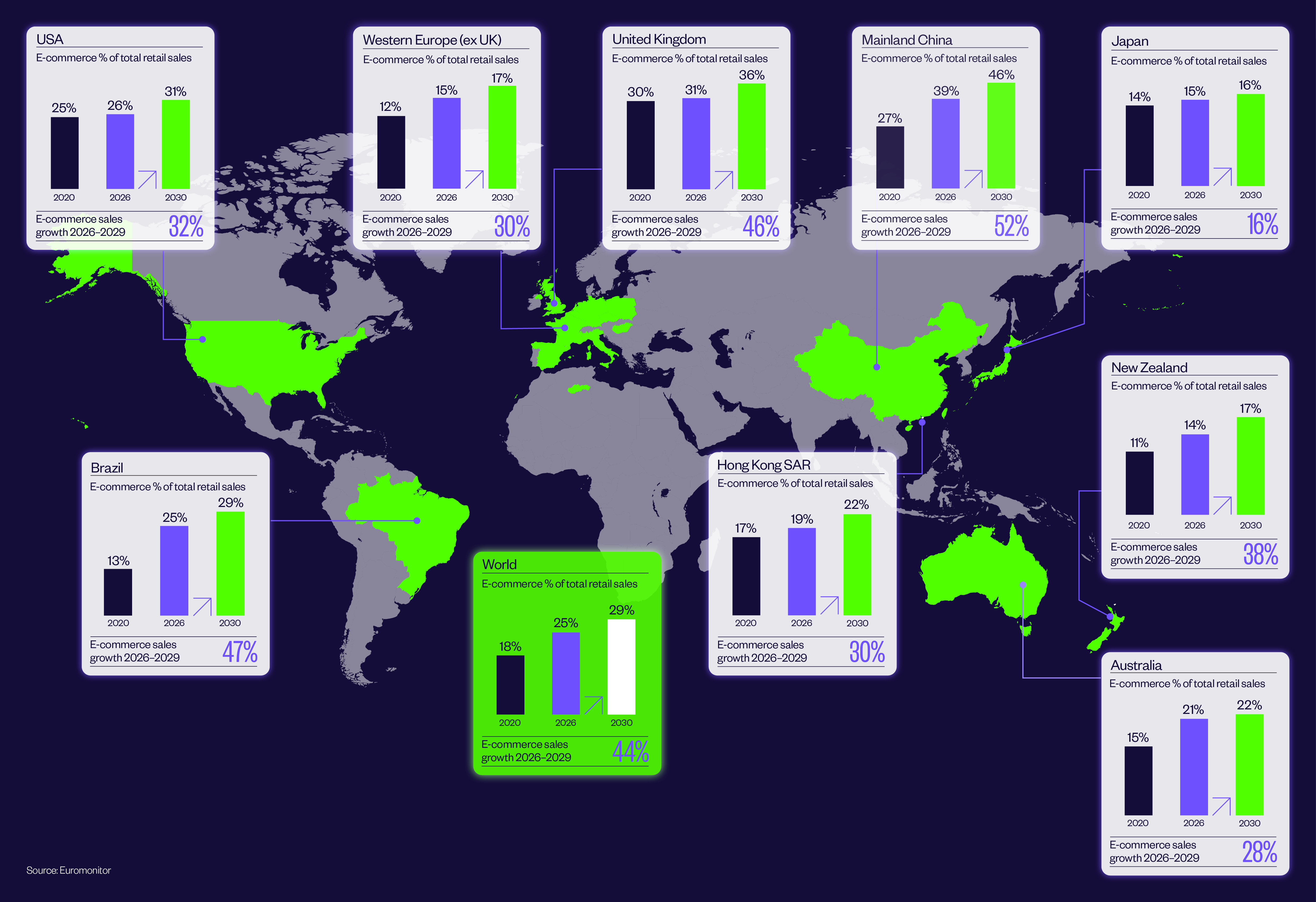
Several key markets highlight this global momentum:
- The United Kingdom remains one of the world’s most advanced e-commerce markets. Online retail accounts for 31% of all retail sales, with further growth forecast to reach 36% by 2030.1
- The United States continues its e-commerce growth, with 26% of retail sales now happening online.
- China remains the global leader, with e-commerce accounting for 39% of total retail sales. The market is expected to expand from US$1.6 trillion in 2026 to US$2.4 trillion by 2030.1
- In Continental Europe, e-commerce accounts for around 15% of total retail sales. The Netherlands and Germany are expected to experience the most rapid growth, increasing by 39% and 35% respectively over the next four years.1
- It’s projected that by 2030 Australia’s e-commerce sales will make up 22% of total retail sales.1
- New Zealand’s e-commerce adoption continues to accelerate, with forecast growth of approximately 38% between 2026 and 2030.1


What’s continuing to fuel the e-commerce boom?
Several trends are accelerating the growth of digital retail.
1: Mobile-first shopping behaviour
Smartphones are now the primary tool for researching and purchasing products online.2 Mobile commerce has transformed the retail experience, enabling consumers to browse, compare and purchase products instantly, and from anywhere.
For retailers, this shift means that intuitive, mobile-first design, frictionless checkout, and web or app-based experiences are no longer optional—they are essential.
2: Social commerce and livestream shopping
Social media continues to be a powerful retail channel. Platforms like YouTube, TikTok and Instagram include shopping features that allow consumers to discover and purchase products without leaving the platform. Livestream commerce is also gaining popularity:
- Around 45% of digital consumers in Asia-Pacific have engaged with livestream shopping 2
- Adoption is highest in China, reaching 74% in 2025 2
- Apparel and accessories are the most purchased livestream products 2
These channels blend entertainment, community and commerce, allowing consumers to interact directly with influencers and sellers. Livestreaming enables shoppers to watch real‑time product demonstrations, ask questions, review live feedback from other buyers, and make purchases instantly. 2
3: Changing consumer expectations
Today’s consumers expect faster, more personalised and more flexible shopping experiences. 2 They want:
- personalised recommendations 2
- real-time product availability 2
- seamless experience across all channels 2
- fast and reliable delivery 2
This change in consumer behaviour is driving retailers to invest heavily in AI, automation, data analytics and supply chain technology to deliver smarter and more responsive shopping experiences.3
At the same time, free delivery and easy returns remain key expectations, highlighting the importance of logistics and fulfilment strategies that prioritise speed and flexibility.
4: Emerging retail strategies
In a highly competitive market, retailers are looking for new ways to attract and retain consumers. According to the latest Euromonitor research, these are the strategies that will reshape how shoppers discover, engage with and purchase products: 4
- GenAI‑driven discovery – As consumers turn to generative AI platforms for product research and recommendations, brands are shifting from traditional search engine marketing to generative engine optimisation (GEO) to drive online visibility. 3
- GenAI-driven checkout – GenAI platforms can now support in‑chat payments, allowing consumers to complete transactions directly within the conversation and reinforcing expectations for frictionless purchasing. 3
- Entertainment-focused content – Brands are investing in entertainment‑led formats such as livestreams, short‑form video and micro‑dramas that blend content, shopping and social interaction to drive engagement and sales. 4
This shift is reinforced by consumer adoption of GenAI. The Voice of the Consumer: Lifestyles Survey 2025 shows that
51% of monthly GenAI users seek product information or recommendations through Gen AI platforms 5
Preparing for the future of retail
1 Euromonitor International, E‑Commerce Analysis (February–March 2026)
2 Euromonitor International, Voice of the Consumer: Digital Shopper Survey 2025
3 Euromonitor International, Voice of the Industry: Global Results 2025
4 Euromonitor International, Top Five Digital Shopper Trends in 2026
5 Voice of the Consumer: Lifestyles Survey 2025, cited in Voice of the Industry: Global Results 2025

About Goodman insights


Goodman insights

A long way from tin sheds: robotics in the supply chain
From picking items and moving pallets, to driving autonomous vehicles, robots and cobots are transforming the way we handle logistics.

Shopping on socials: social commerce
Social media is influencing ecommerce, reshaping consumer shopping experiences, and driving online sales globally.

Consumer trends: here’s what we know
Learn more about key consumer behaviour trends, from digital habits to sustainability, and what businesses need to know to stay ahead.

Digitalising delivery from ports to doorstep
From ports, to trucks, to the final doorstep, advancements in automation technology are transforming delivery in supply chains.

Digital supply chain transformation: from first to last mile
A digitised world demands a digitised supply chain. From manufacturing and warehouses, through to delivery, smart decision-making, and documentation, supply chain technologies are supporting increased productivity and efficiency.

Customer loyalty trends: are consumers loyal?
Learn more about consumer loyalty trends and how businesses can create stronger connections with their customers.